A Star Foot Adventure
Cradle of Memory
by Scot Noel
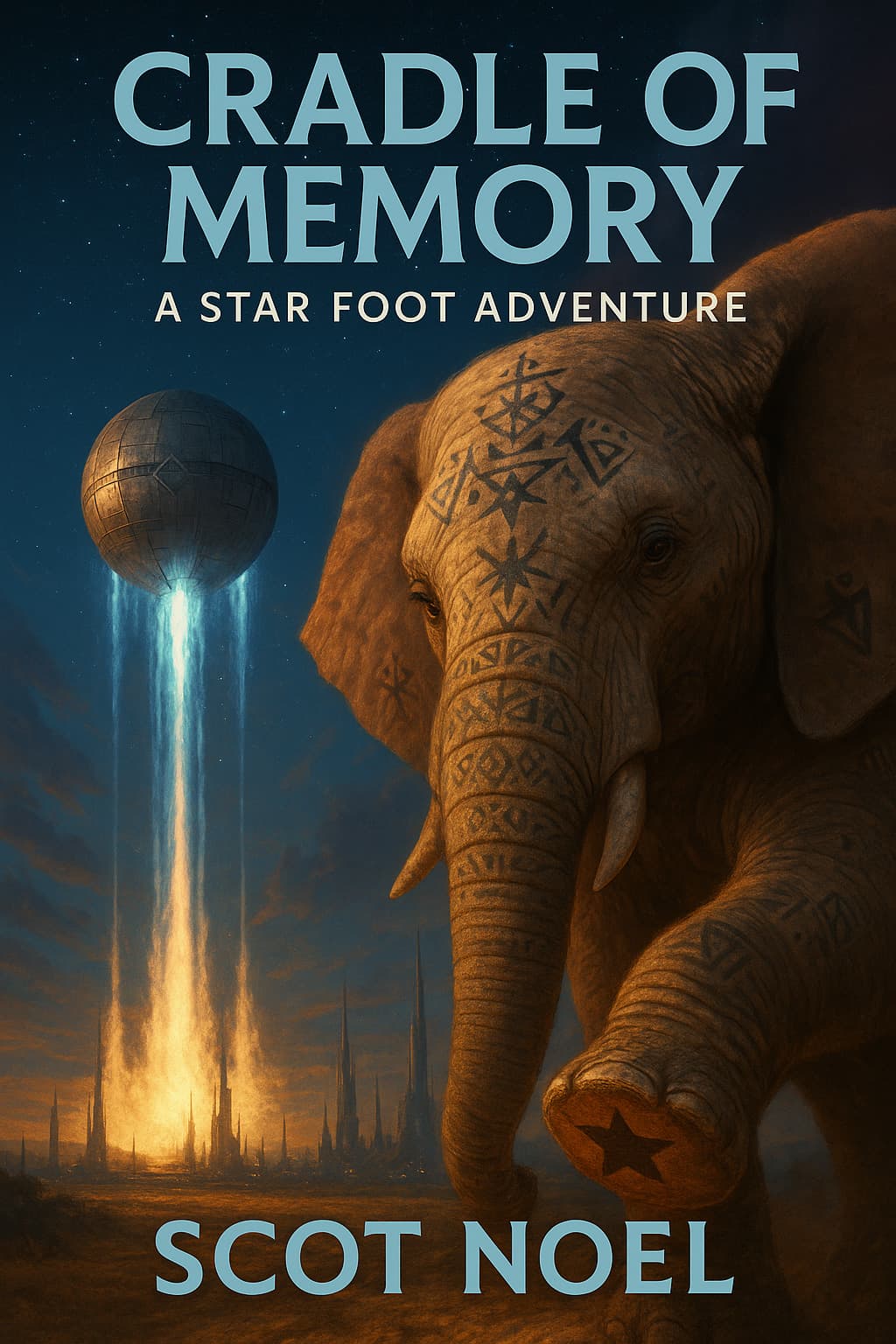
Two Species. One Ancient City. A Secret That Could Change Everything.
In a world where humanity has forgotten its greatest achievements, two young sailors sneak onto a rooftop in the ruins of an Eternal City — and witness something impossible. Lights coming on in towers that have been dark for centuries. And below, in the moonlit parklands, elephants. Not wild animals, but intelligent beings with their own language, their own culture, and their own secrets.
Cradle of Memory is a science fiction adventure that follows four unlikely protagonists — two human, two elephant — as they're swept from the crumbling wonders of Earth to the surface of the Moon, where an ancient intelligence has been waiting for them for two thousand years.
The World
A Far-Future Earth Rebuilt from Ruins
Imagine a far-future Earth where civilization has collapsed and rebuilt itself into something roughly resembling the age of sail and steam — except the ruins of a vastly more advanced society still stand. These are the Eternal Cities: monumental complexes of towers and parklands built by a civilization that mastered artificial intelligence, genetic uplift, and interplanetary travel before tearing itself apart in a war over what it means to be human.
The cities endure. Their walls resist weather and time. Their power systems flicker on and off across the centuries. And within at least one of them, ancient machines called Providers still walk their programmed rounds, tending to systems whose purpose has been long forgotten.
Humanity has moved on. Nations have rebuilt around iron-hulled navies and steam power, while the Eternal Cities stand as monuments to a past no one fully remembers. The great naval powers send expeditions to explore and exploit these ruins, hoping to unlock the technology of the ancients — energy sources that never deplete, materials that resist centuries of weathering, machines that still function long after their makers turned to dust.
When the survey vessel Furious drops anchor off an uncharted city on a jungle coast, its crew expects the usual: dead infrastructure, salvageable materials, another ruin to be catalogued and stripped. What they find instead is a city that's still alive. Power still flows through its systems. Lights still come on at dusk. And deep within its parklands, someone has been living here all along.
The Characters
Four Unlikely Protagonists
Kai
HumanA young sailor aboard the Furious, sharp-eyed, ambitious, and restless for something more. When he spots lights that shouldn’t exist, he drags his best friend into an investigation that will upend both their lives. Kai acts on instinct, trusts his gut, and has the kind of reckless confidence that either gets you killed or makes you a legend.
Dom
HumanKai’s opposite in temperament and his equal in loyalty. Cautious, analytical, and perpetually worried about consequences, Dom is the one who thinks through what Kai charges into. Where Kai leaps, Dom calculates — but when it matters, Dom’s courage runs just as deep.
Sola
ElephantA young elephant with a dangerous habit: she asks questions. Training to become a Moon-Watcher, Sola doesn’t believe the ancestors are sending messages. She believes the moon is another world, and she’s willing to risk everything to prove it. Her curiosity has already cost her status within the herd. It may cost her much more.
Alvin
ElephantSola’s trunk-twin — the elephant equivalent of a bonded sibling — and her most devoted companion. As the story unfolds, Alvin discovers abilities he never knew he had, including the capacity to read the ancient written language that no living elephant has deciphered in centuries.
Together, these four are thrown into an escalating conflict between species, forced aboard an ancient spacecraft, and launched toward the Moon — where the answers they've been seeking turn out to be far more dangerous than the questions.
The Elephants
A Fully Realized Civilization
This isn't a story where animals are props or metaphors. The elephants of Cradle of Memory are a fully realized civilization.
Centuries ago, in the age before the fall, humanity's greatest experiment wasn't building cities or conquering space — it was uplift. Using advanced genetic and neural technology, they elevated elephant cognition to human equivalence and beyond. The project succeeded. Elephants gained language, abstract thought, cultural traditions, and the ability to communicate through both vocalization and deep infrasound channels that carry emotion and meaning simultaneously.
When civilization collapsed, the elephants survived. They built their own society within the walls of the Eternal City — complete with matriarchal governance, ceremonial traditions, sacred tatau markings that tell each elephant's story, and a complex relationship with the Provider machines that still maintain the city's systems.
But elephant society has its own tensions. The ruling matriarch, Arivaska, governs through tradition and caution, suppressing knowledge that might destabilize the herd. A rebel faction called the Star-Foot — named for the secret tattoo its members wear on the soles of their feet — believes in seeking truth regardless of consequences. Their motto: Risk is our business.
When humans arrive at the city walls for the first time in living memory, it's not a meeting between civilization and nature. It's a collision between two intelligent species with competing claims, incompatible communication systems, and centuries of lost context about who built this world and why.
The Conflict
Power, Duty, and Conscience
The crew of the Furious didn't come looking for elephants. They came looking for power — the technology of the ancients, the energy sources that keep the Eternal Cities standing. Commodore Harrington, commanding a growing naval force, sees the city as a strategic prize to be taken. The elephants are an obstacle, not a people.
Captain Drake of the Furious isn't so sure. Her small advance team — including Kai and Dom — has already made peaceful contact with the elephants. She's seen their intelligence firsthand. But Drake is caught between her duty to the Commodore and her growing understanding that this situation is far more complex than a simple military operation.
First Mate Fitzroy watches the escalation with mounting horror, making increasingly bold moral choices to limit the damage — saving wounded elephants, lying to superiors, placing conscience above orders.
On the elephant side, Arivaska faces impossible decisions as Harrington's forces close in. With sixty-two elephants under her protection — including fourteen calves too young to survive without adults — she must choose between standing her ground and leading her herd into the unknown.
And beneath it all, the city's ancient AI — the Guardian — stirs to life, calculating survival probabilities and rewriting its own directives as it confronts a truth its original programmers never anticipated: the elephants aren't animals to be managed. They're citizens to be protected.
The Journey
To the Moon
When an ancient spacecraft activates deep within the city, everything changes. A mixed crew of humans and elephants — chosen by forces they don't fully understand — is launched toward the Moon on a mission none of them asked for.
Inside the sphere, the crew must learn to operate technology that hasn't been used in millennia. Humans sit at control stations facing elephants cradled in berths designed for their massive frames. Neural link technology — headsets that sting like insect bites as they lock into place — bypasses the language barrier entirely, letting human and elephant minds cooperate without words.
The Moon itself is not the dead rock humanity assumes it to be. Its atmosphere, though slowly failing, still supports life. Cities dot its surface. And within a vast dome at the heart of the lunar landscape, an ancient intelligence has been waiting, alone, for two thousand years. What it wants from them will test every bond they've built and force them to make a choice that could reshape the world.
Not everyone will agree on what to do. Not everyone will survive the consequences.
What Kind of Story Is This?
Big-Idea Science Fiction with Heart
It's an adventure story with real stakes: naval battles, desperate escapes, ancient technology reawakening, and a journey across space in a craft no one fully understands. Characters get hurt. Choices have costs. The tension between survival and principle runs through every chapter.
It's a first-contact story told from both sides, where the “aliens” have been living next door the whole time and the real barrier isn't distance — it's the willingness to listen.
It's a story about young people making choices that reshape the world — not because they were chosen by prophecy, but because they were curious enough to look, brave enough to act, and stubborn enough to keep going when the adults told them to stop.
And at its heart, it's a story about empathy: whether it's possible to truly understand a mind radically different from your own, and what happens — to you, to them, to everything — when you try.
For fans of Arthur C. Clarke's sense of wonder, Becky Chambers' interspecies empathy, the moral complexity of Ursula K. Le Guin, and the adventure spirit of Patrick O'Brian — with elephants. If you've ever loved a story that made you see the world through entirely different eyes, this one's for you.
Read the Novel
Follow the Story as It Unfolds
Cradle of Memory is being published chapter by chapter right here on this site. New chapters will be released as they're completed, so you can follow the story as it unfolds — from the first moonlit encounter in the ruins to the journey across space and whatever waits on the other side.